
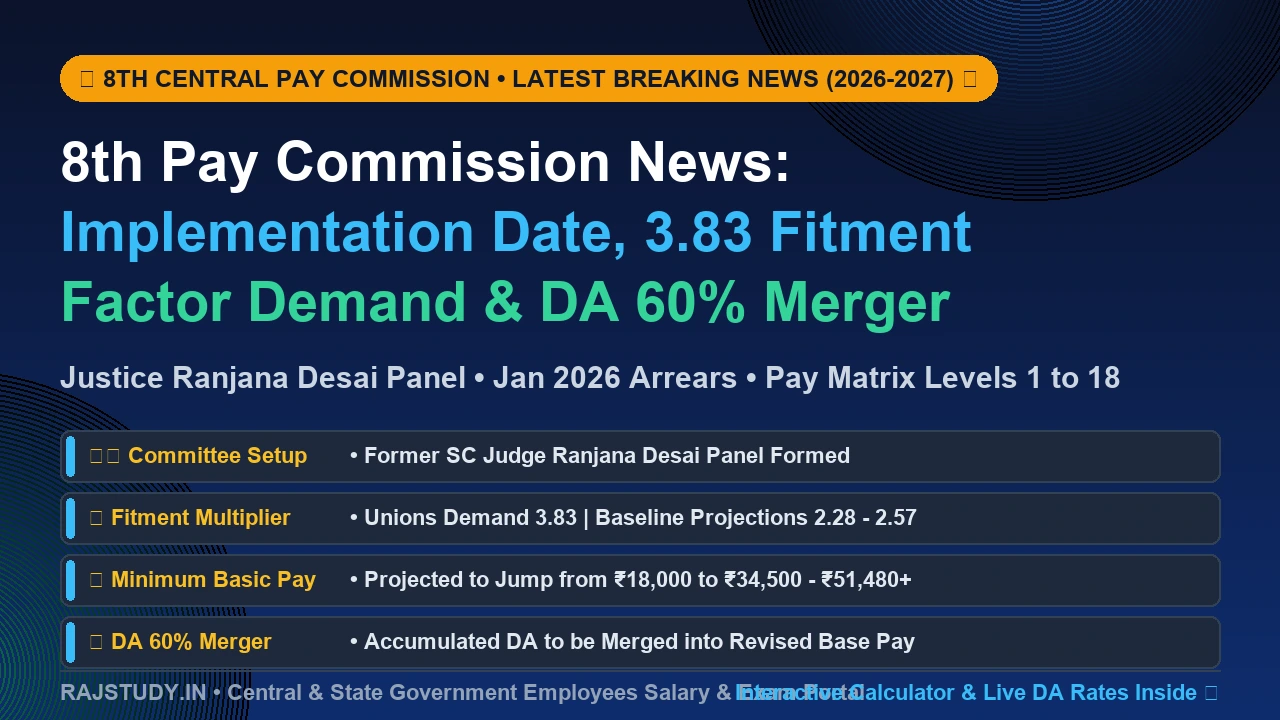
1. 8th Pay Commission Constitution & Implementation Timeline
For over 49 lakh central government employees and 68 lakh pensioners across India, the roadmap for the 8th Central Pay Commission (CPC) has officially begun taking shape. Following extensive memoranda submitted by the Joint Consultative Machinery (Staff Side) and major railway and defence federations, the Central Government has designated the framework for the 8th Pay Commission under the leadership of Former Supreme Court Justice Ranjana Prakash Desai.
Pay Commissions in India are traditionally established every 10 years to review, adjust, and overhaul the compensation framework of civil servants and military personnel to match inflation, cost-of-living indices, and macroeconomic productivity:
- 5th Pay Commission: Implemented effective January 1, 1996.
- 6th Pay Commission: Implemented effective January 1, 2006.
- 7th Pay Commission: Implemented effective January 1, 2016.
- 8th Pay Commission: Reference implementation date set from January 1, 2026.
2. The Fitment Factor Debate: 1.92 vs 2.57 vs Union Demand (3.83)
The single most crucial metric in any Pay Commission is the Fitment Factor (फिटमेंट फैक्टर). It acts as the mathematical multiplier applied directly to an employee's existing 7th CPC Basic Pay to determine their new revised 8th CPC Basic Pay.
Historically, fitment factors have reflected the inflation landscape and budgetary allocations of their respective eras:
- 5th CPC: Applied an effective fitment ratio of 3.06.
- 6th CPC: Applied a fitment factor of 1.86 (plus Grade Pay addition).
- 7th CPC: Recommended a uniform multiplier of 2.57, which raised minimum basic pay from ₹7,000 to ₹18,000.
Why Employee Unions are Demanding a 3.83 Multiplier
The National Council-JCM (Joint Consultative Machinery) and central staff federations have submitted representations arguing that between 2016 and 2026, cumulative consumer price inflation, rising housing costs, medical inflation, and educational expenses have significantly diminished real purchasing power.
Based on the Aykroyd Nutritional Formula and the 15th Indian Labour Conference (ILC) norms, union economists argue that the minimum living wage for a standard family of three consumption units should now be ₹68,940. Dividing ₹68,940 by the existing ₹18,000 basic yields a demanded fitment factor of 3.83.
| Scenario / Proposal | Fitment Factor | Level 1 Minimum Basic | Level 10 (Officer) Basic | Feasibility Analysis |
|---|---|---|---|---|
| Conservative / Minimum | 1.92 | ₹34,560 | ₹1,07,712 | Minimum baseline accounting for 60% DA merger + 20% real hike. |
| Moderate / Balanced | 2.28 | ₹41,040 | ₹1,27,908 | High probability scenario balancing fiscal deficit with employee expectations. |
| 7th CPC Parity | 2.57 | ₹46,260 | ₹1,44,177 | Matches the multiplier adopted by the 7th Central Pay Commission. |
| Staff Union Demand | 3.83 | ₹68,940 | ₹2,14,863 | Demanded by NC-JCM based on modern Aykroyd cost-of-living metrics. |
3. Dearness Allowance (DA) Crossing 50% & The 60% Merger Rule
One of the most frequently asked questions by government servants is: "Does Dearness Allowance automatically merge into basic pay once it crosses 50%?"
Under the older 5th Pay Commission framework, when DA touched 50%, the government enacted a policy called Dearness Pay (DP), merging 50% DA directly into basic pay. However, the 6th and 7th Pay Commissions did not recommend interim automatic merger of DA into basic salary.
Instead, under 7th CPC rules, when DA touched 50% in January 2024, it triggered automatic statutory increases across key allowances:
- House Rent Allowance (HRA): Automatically revised to 30% (X cities), 20% (Y cities), and 10% (Z cities).
- Children Education Allowance (CEA): Increased by 25% to ₹2,812.50 per month per child.
- Hostel Subsidy: Increased by 25% to ₹8,437.50 per month.
- Gratuity Ceiling: Raised from ₹20 Lakhs to ₹25 Lakhs.
4. Live DA Tracking & Historical Hikes on RajStudy
Dearness Allowance is revised twice every year—in January and July—based on the 12-month average of the All India Consumer Price Index for Industrial Workers (AICPI-IW) published by the Labour Bureau of India.
Tracking current and historical DA progression is crucial for both working employees and pensioners because every 1% increment directly translates to substantial take-home raises:
Here is an overview of recent DA milestones under the 7th CPC framework leading into the 8th Pay Commission:
| Effective Period | DA Rate (%) | Increment Hike | Significance / Key Triggers |
|---|---|---|---|
| January 2024 | 50% | +4% | Triggered automatic 25% hike in HRA, CEA, and ₹25 Lakh Gratuity ceiling. |
| July 2024 | 53% | +3% | Crossed the critical 50% milestone, boosting festive Diwali bonus. |
| January 2025 (Projected) | 56% - 57% | +3% to +4% | Reflecting elevated consumer price inflation in essential commodities. |
| July 2025 & Jan 2026 (Projected) | 60% - 62% | +3% to +4% | Final accumulated inflation pool targeted for full 8th CPC merger. |
5. Projected 8th CPC Pay Matrix Table (Levels 1 to 18)
Under the 7th CPC, government employees are categorized into an 18-level Pay Matrix (ranging from Level 1 Group D / MTS to Level 18 Cabinet Secretary). Below is a comparative projection showing current basic salaries versus anticipated 8th CPC basic salaries across two benchmark fitment factors (2.28 and 2.57):
| Pay Level | Representative Designation | 7th CPC Starting Basic | Projected 8th CPC (Factor 2.28) | Projected 8th CPC (Factor 2.57) |
|---|---|---|---|---|
| Level 1 | MTS, Peon, Helper (GP 1800) | ₹18,000 | ₹41,040 | ₹46,260 |
| Level 2 | Junior Assistant, LDC (GP 1900) | ₹19,900 | ₹45,372 | ₹51,143 |
| Level 4 | UDC, Postal Assistant, DEO (GP 2400) | ₹25,500 | ₹58,140 | ₹65,535 |
| Level 6 | Sub-Inspector, Teacher, Grade II (GP 4200) | ₹35,400 | ₹80,712 | ₹90,978 |
| Level 7 | Inspector, Section Officer (GP 4600) | ₹44,900 | ₹1,02,372 | ₹1,15,393 |
| Level 10 | Entry-Level IAS/IPS, SDM, Asst Comm (GP 5400) | ₹56,100 | ₹1,27,908 | ₹1,44,177 |
| Level 12 | Joint Director, Senior Specialist (GP 7600) | ₹78,800 | ₹1,79,664 | ₹2,02,516 |
| Level 14 | Joint Secretary to Govt of India | ₹1,44,200 | ₹3,28,776 | ₹3,70,594 |
| Level 18 | Cabinet Secretary of India | ₹2,50,000 | ₹5,70,000 | ₹6,42,500 |
6. Impact on Pensioners, Dearness Relief (DR) & Gratuity Limits
The recommendations of the 8th Pay Commission will have an immediate transformative impact on India's 68+ lakh civil, defence, and railway pensioners:
- Revision of Basic Pension: Pension is determined at 50% of the last drawn basic pay. With minimum basic pay increasing from ₹18,000 to ₹41,040+ (under factor 2.28), the minimum monthly pension will rise from ₹9,000 to ₹20,520.
- Full Parity Between Pre-2026 and Post-2026 Retirees: In accordance with past Supreme Court rulings and 7th CPC conventions, pension revision formulas will maintain parity across all retirement batches using concordance tables.
- Dearness Relief (DR): Just like working employees, pensioners' DR will reset to 0% on rollout and grow half-yearly.
- Commutation Restoration: Pensioner associations are actively lobbying the 8th CPC panel to reduce the commutation restoration tenure from 15 years to 12 years.
7. How to Calculate Your Take-Home Salary Today
Calculating your projected earnings does not require complex spreadsheets. Follow these 3 simple steps to find your expected 8th Pay Commission salary:
- Find your current 7th CPC Basic Pay on your latest salary slip.
- Select your Pay Matrix Level (Level 1 to Level 18) and city classification (X, Y, or Z).
- Open the RajStudy 8th Pay Commission Salary Calculator and toggle between fitment factors (1.92, 2.28, 2.57, or 3.83).